
CISA KEV Weekly Roundup: 8 Exploited Flaws, 3 Due This Weekend
CISA added eight exploited vulnerabilities to its Known Exploited Vulnerabilities catalog this week, two a day from Monday to Thursday. Two of them are runtime libraries that sit underneath thousands of other products. One is a Cisco firewall VPN flaw. One is a VMware bug whose whole effect is to make an administrator’s actions invisible. Three federal deadlines land this weekend.
What: Eight CVEs added to CISA KEV between Saturday, October 24 and Friday, October 30, 2026: PHP (CVE-2026-109618, CVE-2026-109619), Adobe Commerce/Magento (CVE-2026-48356), Google Brotli (CVE-2026-111497), the Linux kernel (CVE-2026-46300), VMware ESX (CVE-2026-41709), GitLab (CVE-2026-97229) and Cisco Secure Firewall ASA/FTD (CVE-2026-76418).
Status: All eight are confirmed exploited according to CISA. Attribution has been reported for only one (VMware ESX, single-source). CISA lists ransomware use as unknown for every entry we could check.
Deadline: PHP was due Thursday, October 29 (past). Linux kernel: Saturday, October 31. GitLab and Cisco ASA/FTD: Sunday, November 1. Adobe Commerce and Brotli: November 10. VMware ESX: November 11.
Fix: Vendor patches exist for all eight. Start with anything internet-facing: Cisco SSL VPN, GitLab, PHP web tiers and Magento storefronts. Then deal with the Linux kernel and Brotli, which need a full inventory, not a single upgrade.
Key takeaways
- CISA added eight exploited CVEs to KEV this week (October 24–30, 2026), covering PHP, Adobe Commerce, Google Brotli, the Linux kernel, VMware ESX, GitLab and Cisco Secure Firewall ASA/FTD.
- Three deadlines fall this weekend: Linux kernel “Fragnesia” CVE-2026-46300 on October 31, and GitLab CVE-2026-97229 and Cisco ASA/FTD CVE-2026-76418 on November 1.
- The PHP2Shell deadline has already passed. CVE-2026-109618 and CVE-2026-109619 were due October 29. Fixed builds are PHP 8.5.12, 8.4.27, 8.3.36 and 8.2.35.
- Cisco CVE-2026-76418 only affects SSL VPN setups that use secondary authentication. Check every tunnel group, including
DefaultWEBVPNGroup, before deciding you are not exposed. - VMware ESX CVE-2026-41709 is rated CVSS 2.7 but was used as a zero-day, according to one CrowdStrike report. A logging gap on a hypervisor is an evidence problem, not a low-priority one.
- Brotli and the Linux kernel need an inventory, not one patch. Brotli ships inside Node.js, PHP Windows builds, proxies and clients. Fragnesia needs a new kernel and a reboot on every Linux host.
Executive Summary
This was a week of shared components. Four of the eight additions are not products most CISOs buy directly: a PHP interpreter, a compression library, an operating system kernel and an e-commerce framework. They reach your estate through other software, which makes them harder to inventory and slower to patch than a single appliance.
CISA added the entries in pairs. On Monday, October 26, it listed the two PHP2Shell remote code execution flaws, which DataWater covered in detail on Tuesday. On Tuesday, October 27, it added Adobe Commerce CVE-2026-48356 and the Brotli decoder bug CVE-2026-111497, known as Node2Shell, which we broke down on Wednesday. On Wednesday, October 28, it added the Linux kernel flaw Fragnesia, covered here Thursday, and a low-rated VMware ESX logging flaw. On Thursday, October 29, it added the CVSS 10.0 GitLab bug and a Cisco firewall VPN crash flaw.
As of Friday morning, we had not seen a new KEV alert dated October 30. Check the catalog before close of business.
The bottom line: patch the internet-facing four (Cisco SSL VPN, GitLab, PHP and Magento) first, then run the kernel and Brotli hunts, and preserve VMware ESX logs before you upgrade.
Why This Matters to CISOs and Security Leaders
Chains, not single bugs. CISA’s own description of the Linux kernel entry says Fragnesia can be chained with the PHP2Shell bugs to plant web shells and run commands as root, according to one analysis of the KEV entry. A web server that is “only” running an old PHP build may be one step away from a full host takeover.
Weekend deadlines. Three of this week’s due dates fall on Saturday and Sunday. If your change process freezes on Fridays, those deadlines effectively moved to today.
Low scores still matter. VMware ESX CVE-2026-41709 carries a vendor score of 2.7. It still made the KEV list because, according to a CrowdStrike report summarized by one secondary source, a China-nexus group used it as a zero-day inside vCenter environments. Teams that triage by CVSS alone would have skipped it.
Ask your team for two lists by Monday: every host running PHP, Node.js or a Brotli-linked service, and every Linux kernel still below the fixed builds. If nobody can produce either list in a day, the gap is asset inventory, not patching speed.
The Timeline
| Date (2026) | What happened |
|---|---|
| Friday, Oct 23 | CISA adds Arista VeloCloud Orchestrator CVE-2026-114625 and Collabora CVE-2026-110447 (before this week’s window; see below) |
| Saturday, Oct 24 | A researcher confirms PHP2Shell remote code execution against honeypots, per The Hacker News |
| Monday, Oct 26 | CISA adds PHP CVE-2026-109618 and CVE-2026-109619 |
| Tuesday, Oct 27 | CISA adds Adobe Commerce CVE-2026-48356 and Google Brotli CVE-2026-111497 |
| Wednesday, Oct 28 | CISA adds Linux kernel CVE-2026-46300 and VMware ESX CVE-2026-41709. Cisco publishes its ASA/FTD advisory. |
| Thursday, Oct 29 | CISA adds GitLab CVE-2026-97229 and Cisco ASA/FTD CVE-2026-76418. PHP2Shell deadline passes. |
| Saturday, Oct 31 | Linux kernel CVE-2026-46300 due |
| Sunday, Nov 1 | GitLab CVE-2026-97229 and Cisco CVE-2026-76418 due |
| Tuesday, Nov 10 | Adobe Commerce CVE-2026-48356 and Brotli CVE-2026-111497 due |
| Wednesday, Nov 11 | VMware ESX CVE-2026-41709 due |
Half of this week’s KEV list is code you never bought directly. It arrived inside something else.
Vulnerability & Exploit Analysis
One section per CVE, in the order CISA added them. Each one gives the product, the flaw, the federal due date and the first thing to do.
1–2. PHP: CVE-2026-109618 and CVE-2026-109619 (“PHP2Shell”)
Product: PHP (PHP Group). Flaw: Two unauthenticated remote code execution bugs, each rated CVSS 9.2. CVE-2026-109618 is a memory-corruption flaw. CVE-2026-109619 involves stale internal request state. Added: October 26. Due: October 29 (passed). First action: Move to PHP 8.5.12, 8.4.27, 8.3.36 or 8.2.35 (released October 21), then restart every PHP worker so the old code stops running. A researcher confirmed working exploitation against honeypots on October 24, though in a deliberately favorable single-worker setup. Full analysis: PHP2Shell CVE-2026-109618.
3. Adobe Commerce and Magento Open Source: CVE-2026-48356
Product: Adobe Commerce and Magento Open Source. Flaw: Unrestricted upload of a dangerous file type (CWE-434), rated CVSS 9.3. Adobe’s record says exploitation needs a victim to open a crafted URL or interact with a compromised page, which could lead to code execution. Added: October 27. Due: November 10. First action: Apply the July 2026 patch for your release line from Adobe bulletin APSB26-73. The fix has been available since July, so any unpatched storefront is three months behind.
4. Google Brotli: CVE-2026-111497 (“Node2Shell”)
Product: Google’s Brotli compression library. Flaw: A decoder memory-corruption bug triggered by a crafted Brotli-compressed stream. CISA’s entry describes it as an unchecked return value; the NVD record calls it an out-of-bounds write. A remote, unauthenticated attacker can corrupt memory, leak data, crash the process or possibly run code. Added: October 27. Due: November 10. First action: Upgrade Brotli to 1.0.10, 1.1.1 or 1.2.1 (affected: 1.0.3 through 1.2.0), and apply vendor updates for anything that bundles it, including Node.js and PHP Windows builds. One report says honeypots logged exploitation attempts and that Imperva demonstrated code execution against an official Node.js image. Full analysis: Node2Shell CVE-2026-111497.
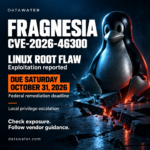
5. Linux kernel: CVE-2026-46300 (“Fragnesia”)
Product: Linux kernel, XFRM ESP-in-TCP code. Flaw: A local privilege escalation (CVSS 7.8) in which merged network buffers lose a shared-memory marker, letting a low-privileged user overwrite read-only files in the page cache and gain root. The bug dates back to Linux 3.9 and has had a public proof of concept since May. Added: October 28. Due: Saturday, October 31. First action: Install your distribution’s fixed kernel and reboot. Upstream fixes are in 5.10.257, 5.15.208, 6.1.174, 6.6.141, 6.12.91, 6.18.33, 7.0.10 and 7.1. If you don’t use IPsec, block the esp4 and esp6 modules as a stopgap. On internet-facing hosts, look for compromise before rebooting, since a reboot can wipe in-memory evidence. Full analysis: Fragnesia CVE-2026-46300.
6. VMware ESX: CVE-2026-41709
Product: Broadcom VMware ESX (also in VMware Cloud Foundation, vSphere Foundation and Telco Cloud Platform). Flaw: Insufficient logging (CWE-778). An administrator with ESX access could perform some operations without them being logged. Broadcom has not said which operations. Broadcom scores it CVSS 2.7. Added: October 28. Due: November 11. First action: Apply the fixed builds from Broadcom advisory VMSA-2026-0006 (for example ESXi80U3j-25429389 for ESX 8.0, ESXi-9.0.2.0100-25595025 for 9.0). Broadcom lists no workaround and has not said whether ESX 7.0 is affected.
7. GitLab CE/EE: CVE-2026-97229
Product: GitLab Community and Enterprise Editions, self-managed. Flaw: An integer overflow in GitLab’s CI/CD regular expression compiler, rated CVSS 10.0. A crafted regular expression in CI/CD configuration can let an unauthenticated attacker run code on the server. Added: October 29. Due: Sunday, November 1. First action: Upgrade to 19.2.8, 19.3.5 or 19.4.2 or later. One analysis says GitLab recommends 19.3.5 over 19.3.4 because 19.3.4 introduced an unrelated bug. GitLab.com is already patched, and GitLab Dedicated customers don’t need to act. Our launch briefing: GitLab CVE-2026-97229.
8. Cisco Secure Firewall ASA and FTD: CVE-2026-76418
Product: Cisco Secure Firewall Adaptive Security Appliance and Firewall Threat Defense software. Flaw: An unchecked return value causes a NULL pointer dereference. An unauthenticated remote attacker can force the device to reload, a denial of service. CVSS 8.6. Cisco does not describe code execution. Added: October 29. Due: Sunday, November 1. First action: Check whether you are actually exposed. A device must run an affected release, have the SSL remote-access VPN reachable, and use secondary authentication on at least one tunnel group. If all three are true, upgrade (table below). Cisco advisory: cisco-sa-asaftd-tunnel-dos-s6mgkb75.
Affected and fixed versions
| CVE | Product | Fixed in | Due |
|---|---|---|---|
| CVE-2026-109618 / -109619 | PHP | 8.5.12, 8.4.27, 8.3.36, 8.2.35 | Oct 29 (passed) |
| CVE-2026-48356 | Adobe Commerce / Magento Open Source (2.4.9, 2.4.8-p5 and earlier) | July 2026 patches, bulletin APSB26-73 | Nov 10 |
| CVE-2026-111497 | Google Brotli 1.0.3 – 1.2.0 | 1.0.10, 1.1.1, 1.2.1 (plus bundling vendors’ updates) | Nov 10 |
| CVE-2026-46300 | Linux kernel (since 3.9) | 5.10.257, 5.15.208, 6.1.174, 6.6.141, 6.12.91, 6.18.33, 7.0.10, 7.1; distro kernels | Oct 31 |
| CVE-2026-41709 | VMware ESX 8.0, 9.0, 9.1; VCF ESX 5.x | ESXi80U3j-25429389; ESXi-9.0.2.0100-25595025; ESXi-9.1.0.0-25370933; VCF 5.2.4 | Nov 11 |
| CVE-2026-97229 | GitLab CE/EE 19.2–19.4 | 19.2.8, 19.3.5, 19.4.2 | Nov 1 |
| CVE-2026-76418 | Cisco ASA | 9.16.4.104, 9.18.4.96, 9.20.4.50, 9.22.3.200, 9.23.1.48, 9.24.1.27 or 9.24.10.1 | Nov 1 |
| CVE-2026-76418 | Cisco FTD | 7.0.11, 7.2.13, 7.4.9, 7.6.7, 7.7.14, 10.0.3, 10.1.1 | Nov 1 |
Missed by last week’s roundup
Last Friday’s KEV roundup went out before CISA’s Friday, October 23 additions, so two entries fell between windows. Both had federal deadlines of Monday, October 26: Arista VeloCloud Orchestrator CVE-2026-114625 and Collabora CVE-2026-110447. If either is in your estate and still unpatched, it is past due.
The VMware entry is the odd one out, and it deserves more attention than its 2.7 score suggests. An insufficient-logging flaw does not break in. It hides what an intruder with admin access did afterward. If it was used as a zero-day, as one report says, then the ESX logs you would normally rely on to answer “what did they touch?” may be incomplete for the period before you patched. Treat any past hypervisor incident review as possibly missing data.
Threat Intelligence Breakdown
Attribution: Mostly unknown. CISA has not named an actor for any of this week’s eight entries. Cisco has not disclosed who is exploiting CVE-2026-76418, how many organizations were targeted or what happened after the crashes.
VMware ESX (single-source): According to one secondary analysis, a CrowdStrike report dated October 28 says the China-nexus actor it tracks as WARP PANDA used CVE-2026-41709 as a zero-day in intrusions into vCenter environments, including U.S. legal-sector targets. DataWater has not seen CrowdStrike’s full report and no indicators have been published.
Linux kernel and PHP chain (unconfirmed): One analysis cites Palo Alto Networks Unit 42 and another research group as reporting PHP2Shell exploitation chained with Fragnesia against PAN-OS systems. That analysis says it could not verify the claims, and CISA has not confirmed them.
GitLab: The Hacker News reports that Alpine Linux disclosed a failed attack on its unpatched GitLab instance on October 20–21, with crafted CI configurations crashing workers eight times. Further attempts on October 25–26 were blocked. Alpine found no evidence of success but rebuilt the server as a precaution.
Indicators of compromise: None of the vendors or CISA published IoCs for this week’s eight CVEs in the sources we reviewed, so this briefing does not include an IoC table. For hunting, use behavior: unexpected reloads on Cisco SSL VPN devices, crashing GitLab workers, new PHP files in web roots and unexplained root processes on Linux web hosts.
Enterprise Impact
Remote access: A Cisco SSL VPN that reboots on demand is a business outage, and repeated reloads can mask other activity. Organizations relying on secondary authentication for VPN logins are the ones exposed.
Software supply chain: GitLab servers hold source code, CI/CD secrets and cloud deployment credentials. Code execution there can turn into access to production and to customers.
Web and e-commerce tiers: PHP, Magento and Brotli sit in front of customers. A compromise there can mean payment-page tampering, data theft or a beachhead for the kernel exploit.
Virtualization and evidence: The ESX logging gap affects your ability to prove what did or did not happen on a hypervisor, which matters for incident reports, insurers and regulators.
What Security Leaders Should Do Next
Today
- Cisco ASA/FTD: check every tunnel group, including
DefaultWEBVPNGroup, forsecondary-authentication-server-group. If exposed, upgrade or apply Cisco’s temporary mitigation, and send any unexplained reloads to Cisco TAC. - GitLab: upgrade self-managed instances to 19.2.8, 19.3.5 or 19.4.2 and confirm the application version, not just the Helm chart version.
- PHP: confirm every host is on a fixed PHP build and that all workers have restarted. This deadline has already passed.
- Linux: start kernel updates on internet-facing web hosts first, checking for compromise before each reboot.
Within 48 hours
- Finish the Linux kernel rollout across the fleet, including containers’ host nodes and appliances built on Linux.
- Build a Brotli inventory: Node.js, PHP Windows builds, reverse proxies, HTTP clients and anything else that decompresses Brotli. Patch the internet-facing ones first.
- Export ESX logs before upgrading to the VMSA-2026-0006 builds, then patch.
- Patch Magento storefronts with APSB26-73 and check for unexpected uploaded files.
Long-term
- Track shared components, not just products. Keep a software bill of materials that can answer “where do we run Brotli?” in minutes.
- Stop triaging KEV entries by CVSS. Being on the KEV list means confirmed exploitation, whatever the score.
- Pre-approve weekend emergency changes for edge devices and CI/CD platforms, because CISA deadlines do not respect change freezes.
Get zero-day alerts before they hit the headlines
DataWater’s executive threat briefing: the exploited CVEs, the deadlines and the first three actions to take.
Winners and Losers
| Better positioned | More exposed |
|---|---|
| Teams with an SBOM that lists Brotli and PHP versions | Teams that only track the products they buy |
| GitLab.com and GitLab Dedicated customers (already patched) | Self-managed GitLab owners on 19.2–19.4 builds |
| Cisco VPN deployments without secondary authentication | VPNs that rely on secondary authentication for every login |
| Magento shops that applied July’s APSB26-73 patches | Storefronts three months behind on Adobe updates |
| SOCs that triage by KEV status first | Programs that defer anything below CVSS 7 |
Final Executive Takeaway
Eight exploited flaws, three weekend deadlines, and one big lesson: inventory beats speed.
The Cisco and GitLab fixes are single upgrades on systems you know you own. The PHP, Brotli and Linux kernel fixes depend on knowing where that code runs, and the VMware entry reminds you that patching does not restore missing logs.
Patch the edge today. Inventory the shared components this weekend. Save the hypervisor logs before you upgrade.
Frequently Asked Questions
Which vulnerabilities did CISA add to the KEV catalog the week of October 24–30, 2026?
CISA added eight exploited vulnerabilities to the KEV catalog between October 24 and October 30, 2026: PHP CVE-2026-109618 and CVE-2026-109619, Adobe Commerce CVE-2026-48356, Google Brotli CVE-2026-111497, Linux kernel CVE-2026-46300, VMware ESX CVE-2026-41709, GitLab CVE-2026-97229 and Cisco Secure Firewall ASA/FTD CVE-2026-76418.
When is the CISA deadline for Cisco ASA/FTD CVE-2026-76418?
CISA added Cisco Secure Firewall ASA and FTD CVE-2026-76418 to its Known Exploited Vulnerabilities catalog on October 29, 2026, with a federal due date of November 1, 2026. The flaw lets an unauthenticated attacker force a reload on devices with SSL VPN and secondary authentication enabled.
Am I affected by Cisco CVE-2026-76418 if I run an ASA firewall?
Only if three conditions are all true: the Cisco ASA or FTD device runs an affected release, its SSL remote-access VPN is reachable, and at least one tunnel group uses secondary authentication. Cisco says to check every tunnel group, including DefaultWEBVPNGroup, for CVE-2026-76418 exposure.
What are the fixed GitLab versions for CVE-2026-97229?
Self-managed GitLab CE and EE should upgrade to 19.2.8, 19.3.5 or 19.4.2 or later to fix CVE-2026-97229. CISA added the CVSS 10.0 GitLab flaw to KEV on October 29, 2026 with a November 1 deadline. GitLab.com is already patched and GitLab Dedicated customers do not need to act.
Why is VMware ESX CVE-2026-41709 on the KEV list with a CVSS score of 2.7?
VMware ESX CVE-2026-41709 is an insufficient-logging flaw that lets an administrator perform some actions without logs. CISA added it to KEV on October 28, 2026 because it was exploited; one report citing CrowdStrike says a China-nexus group used it as a zero-day. KEV listing reflects exploitation, not severity score.
What is the deadline for the Linux kernel Fragnesia flaw CVE-2026-46300?
CISA set an October 31, 2026 federal deadline for Linux kernel CVE-2026-46300 (Fragnesia), a local root escalation it added to KEV on October 28. Fixing CVE-2026-46300 requires installing a patched kernel and rebooting each host.
Is the PHP2Shell deadline already past?
Yes. CISA added PHP2Shell CVE-2026-109618 and CVE-2026-109619 to KEV on October 26, 2026, with a federal deadline of October 29, 2026. Fixed PHP releases for the PHP2Shell flaws are 8.5.12, 8.4.27, 8.3.36 and 8.2.35.
Sources
Primary sources: CISA Known Exploited Vulnerabilities catalog and CISA KEV alerts of October 26–29, 2026 (the CISA site could not be loaded directly during this run; dates added and due dates are taken from reporting that cites the catalog and CISA’s alerts). Vendor advisories referenced as cited in that reporting: Cisco cisco-sa-asaftd-tunnel-dos-s6mgkb75, Broadcom VMSA-2026-0006, Adobe APSB26-73 and GitLab’s security release for CVE-2026-97229. Additional reporting reviewed: The Hacker News (GitLab and Cisco KEV), The Hacker News (PHP2Shell), BleepingComputer (GitLab), SOCRadar (GitLab fixed builds), SecurityOnline (Adobe Commerce and Brotli), SQ Magazine (Brotli), Rescana (Cisco ASA/FTD, VMware ESX, Linux kernel, Arista VeloCloud and Collabora analyses) and Senserva (weekly KEV list). Single-source claims are labeled. Reflects public reporting as of October 30, 2026.